Mostrando entradas con la etiqueta Sights. Mostrar todas las entradas

lunes, 31 de diciembre de 2012

Greek sculptures

Venus of Milo
Venus of Milo:
Aphrodite of Milos (Greek: Ἀφροδίτη τῆς Μήλου, Aphroditē tēs Mēlou), better known as the Venus de Milo, is an ancient Greek statue and one of the most famous works of ancient Greek sculpture. Created sometime between 130 and 100 BC, it is believed to depict Aphrodite, the Greek goddess of love and beauty (Venus to the Romans). It is a marble sculpture, slightly larger than life size at 203 cm (6 ft 8 in) high. The arms and original plinth were lost following the discovery. From an inscription that was on its plinth, it is thought to be the work of Alexandros of Antioch; earlier, it was mistakenly attributed to the master sculptor Praxiteles. It is currently on permanent display at the Louvre Museum in Paris.
Description:

Although the Aphrodite of Milos is widely renowned for the mystery of her missing arms enough evidence remains to prove that the right arm of the statue was lowered across the torso with the right hand resting on her raised left knee so it would seem to hold the sliding drapery wrapped around the hips and legs in place.[citation needed] There is a filled hole below her right breast that originally contained a metal tenon that would have supported the separately carved right arm.
The left arm was held out below the eye level of the statue, above a herm and held an apple. The right side of the statue is worked more carefully and finished in greater detail than the left side or back, indicating that the statue was intended to be viewed in profile from its right. The left hand would have held the apple up into the air further back inside the niche the statue was set in. When the left hand was still attached, it would have been clear to an observer that the goddess was looking at the apple she held up in her left hand.
The statue would have been painted, as was the Greek custom for statuary,adorned with jewellery, and positioned in a niche inside a gymnasium. The painting of the statue along with the bedecking in jewellery were intended to make it appear more lifelike. Today, all traces of any paint have disappeared and the only signs of the armbands, necklace, earrings and crown are attachment holes.
The twisting stance and strong projection of the knee, as well as the rich, three-dimensional quality of the drapery, are typical of Hellenistic art of the third century BC and later. Moreover, the sensuous juxtaposition of flesh with the texture of drapery, which seems about to slip off the figure, adds an insistent note of erotic tension that is thoroughly Hellenistic in concept and intent.

lunes, 24 de diciembre de 2012

Greek sculptures

Antikythera Ephebe:
Antikythera Ephebe
The Antikythera Ephebe is a bronze statue of a young man of languorous grace that was found in 1900 by sponge-divers in the area of an ancient shipwreck off the island of Antikythera, Greece. It was the first of the series of Greek bronze sculptures that the Aegean and Mediterranean yielded up in the twentieth century which have fundamentally altered the modern view of Ancient Greek sculpture.The wreck site, which is dated about 70–60 BC, also yielded the Antikythera Mechanism, an astronomical calculating device, a characterful head of a Stoic philosopher, and a hoard of coins. The coins included a disproportionate quantity of Pergamene cistophoric tetradrachms and Ephesian coins, leading scholars to surmise that it had begun its journey on the Ionian coast, perhaps at Ephesus; none of its recovered cargo has been identified as from mainland Greece.
The Ephebe, which measures 1.94 meters, slightly over lifesize, was retrieved in numerous fragments. Its first restoration was revised in the 1950s, under the direction of Christos Karouzos, changing the focus of the eyes, the configuration of the abdomen, the connection between the torso and the right upper thigh and the position of the right arm; the re-restoration is universally considered a success.
Antikythera Ephebe

The Ephebe does not correspond to any familiar iconographic model, and there are no known copies of the type. He held a spherical object in his right hand,and possibly may have represented Paris presenting the Apple of Discord to Aphrodite; however, since Paris is consistently depicted cloaked and with the distinctive Phrygian cap, other scholars have suggested a beardless, youthful Heracles with the Apple of the Hesperides. It has also been suggested that the youth is a depiction of Perseus holding the head of the slain Gorgon. At any rate, the loss of the context of the Antikythera Ephebe has stripped it of its original cultural meaning.
The Ephebe, dated by its style to about 340 BC, is one of the most brilliant products of Peloponnesan bronze sculpture; the individuality and character it displays have encouraged speculation on its possible sculptor: perhaps it is the work of the famous sculptor Euphranor, trained in the Polyclitan tradition, who did make a sculpture of Paris, according to Pliny:
"By Euphranor is an Alexander [Paris]. This work is specially admired, because the eye can detect in it at once the judge of the goddesses, the lover of Helen, and yet the slayer of Achilles."
The Antikythera Ephebe is conserved in the National Archaeological Museum of Athens.


sábado, 15 de diciembre de 2012

Greek monuments

Agora:
The agora (Ancient Greek: Ἀγορά, Agorá) was a central spot in ancient Greek city-states. The literal meaning of the word is "gathering place" or "assembly". The agora was the center of athletic, artistic, spiritual and political life of the city. The Ancient Agora of Athens was the best-known example, birthplace of democracy.
Origins:

Early in Greek history (10th century–8th century BC), free-born male land-owners who were citizens would gather in the agora for military duty or to hear statements of the ruling king or council. Later, the agora also served as a marketplace where merchants kept stalls or shops to sell their goods amid colonnades.


From this twin function of the agora as a political and commercial space came the two Greek verbs ἀγοράζω, agorázō, "I shop", and ἀγορεύω, agoreúō, "I speak in public". The word agoraphobia, the fear of open spaces or public situations, derives from the meaning of agora as a gathering place.
The Forum was the Roman equivalent of the agora and the word is often used in older texts to refer to Greek agoras.

miércoles, 5 de diciembre de 2012

Greek sculptures

Herarion of Argos
Heraion of Argos:
The Heraion of Argos (Greek: Ἡραῖον Ἄργους) was the temple in the greatest sanctuary in the Argolid, dedicated to Hera, whose epithet "Argive Hera" (Ἥρη Ἀργείη Here Argeie), is familiar to readers of Homer. Hera herself claims to be the protector of Argos in Iliad IV, 50–52): "The three towns I love best are Argos, Sparta and Mycenae of the broad streets". The memory was preserved at Argos of an archaic, aniconic pillar representation of the Great Goddess. The site, which might mark the introduction of the cult of Hera in mainland Greece, lies northeast of Argos between the archaeological sites of Mycenae and Midea (Argolid)[37°41′31″N 22°46′29″ two important Mycenaean cities. The traveller Pausanias, visiting the site in the 2nd century CE, referred to the area as Prosymna (Προσύμνη).
The temenos occupies three artificially terraced levels on a site above the plain with a commanding view. The Old Temple, destroyed by fire in 423 BCE, and an open-air altar stood on the uppermost terrace. The famous ivory and gold-plated bronze sculpture of Hera by Polykleitos stood in the New Temple on the middle terrace, built by Eupolemos of Argos following the fire. There were other structures, one of which was the earliest example of a building with an open peristyle court, surrounded by columned stoas. The lowest level supports the remains of a stoa. Ancient retaining walls support the flat terraces.

Close to the Heraion a Mycenaean cemetery apparently a site of an ancestor cult in the Geometric period was excavated by Carl Blegen. In Roman times a baths and a palaestra were added near the site.
At the Heraion, Agamemnon was chosen to lead the Argives against Troy, according to a legend recorded by Dictys of Crete. Walls and earliest finds at the site date to the Geometric period, during which the Iliad was composed. A Helladic settlement preceded the sanctuary's development.
The British officer Thomas Gordon was the first to identify the site in 1831, and in 1836 he conducted some desultory excavations. Heinrich Schliemann briefly investigated the site in 1874 before modern archaeology at the Heraion began, under the auspices of the Archaeological Institute of America, which chose the Argive Heraion in its first campaign of excavation in Greece, under the direction of Charles Waldstein, who discovered a bundle of iron roasting spits (oboloi) in a bundle of 180, together with a solid bar of iron weighing the same as the bundle and having the same length (about 120 centimeters), votive objects that served as standards of weight and measure, introduced by Pheidon of Argos which were still to be seen in Classical times. "The obols of the Heraion are mentioned by the philosopher Heracleides of Pontus in his work on Etymologies in order to explain the origin of the name of the monetary unit obol, which is 1/6 of drachma" (Stecchini).

sábado, 24 de noviembre de 2012

Greek sculptures

The Townley Discobolus 
Discobolus:

The Diskobolus of Myron ("discus thrower" Greek Δισκοβόλος, "Diskobólos") is a famous Greek sculpture that was completed towards the end of the Severe period, circa 460-450 BC. The original Greek bronze is lost. It is known through numerous Roman copies, both full-scale ones in marble, such as the first to be recovered, the Palombara Discopolus, or smaller scaled versions in bronze. A discus thrower is depicted about to release his throw: "by sheer intelligence", Sir Kenneth Clark observed in The Nude (1956: p 239f) "Myron has created the enduring pattern of athletic energy. He has taken a moment of action so transitory that students ok athletics still debate if it is feasible, and he has given it the completeness of a cameo." The moment thus captured in the statue is an example of rhythmos, harmony and balance. Myron is often credited with being the first sculptor to master this style. Naturally, as always in Greek athletics, the Discobolus is completely nude. His pose is said to be unnatural to a human, and today considered a rather inefficient way to throw the discus. Also there is very little emotion shown in the discus thrower's face, and "to a modern eye, it may seem that Myron's desire for perfection has made him suppress too rigorously the sense of strain in the individual muscles," Clark observes. The other trademark of Myron embodied in this sculpture is how well the body is proportioned, the symmetria.
The potential energy expressed in this sculpture's tightly-wound pose, expressing the moment of stasis just before the release, is an example of the advancement of Classical sculpture from Archaic. The torso shows no muscular strain, however, even though the limbs are outflung.

Other Roman copies in marble have been recovered, and torsoes that were already known in the seventeenth century but that had been wrongly restored and completed, have since been identified as further repetitions after Myron's model. For one such example, in the early eighteenth century Pierre-Étienne Monnot restored a torso that is now recognized as an example of Myron's Discobolus as a Wounded Gladiator who supports himself on his arm as he sinks to the ground; the completed sculpture was donated before 1734 by Pope Clement XII to the Capitoline Museums, where it remains.
Yet another copy was discovered in 1906 in the ruins of a Roman villa at Tor Paterno in the former royal estate of Castel Porziano, now also conserved in the Museo Nazionale Romano.


miércoles, 14 de noviembre de 2012

Greek monuments

Acropolis of Athens:

The Acropolis of Athens (Greek: Ακρόπολη Αθηνών) is an ancient citadel located on a high rocky outcrop above the city of Athens and containing the remains of several ancient buildings of great architectural and historic significance, the most famous being the Parthenon. Although there are many other acropoleis in Greece, the significance of the Acropolis of Athens is such that it is commonly known as "The Acropolis" without qualification.
Acropolis of Athens
The Acropolis was formally proclaimed as the preeminent monument on the European Cultural Heritage list of monuments on 26 March 2007.

The Acropolis Restoration Project:
The Project began in 1975 and is now nearing completion. The aim of the restoration was to reverse the decay of centuries of attrition, pollution, destruction by acts of war, and misguided past restorations. The project included collection and identification of all stone fragments, even small ones, from the Acropolis and its slopes and the attempt was made to restore as much as possible using reassembled original material (Anastylosis) - with new marble from Mount Penteli used sparingly. All restoration was made using titanium dowels and is designed to be completely reversible, in case future experts decide to change things. A combination of cutting-edge modern technology and extensive research and reinvention of ancient techniques were used.
View of the Acropolis from the Agora.

Cultural significance:
Every four years, the Athenians held a festival called the Panathenaea that rivaled the Olympic Games in popularity. During the festival, a procession (believed to be depicted on the Parthenon frieze) traveled through the city via the Panathenaic Way and culminated on the Acropolis. There, a new robe of woven wool (peplos) was placed on either the statue of Athena Polias in the Erechtheum (during a regular Panathenaea) or on the statue of Athena Parthenos in the Parthenon (during the Great Panathenaea, held every four years).
Within the later tradition of Western Civilization and classical revival the Acropolis, from at least the mid-18th century on, has often been invoked as a key symbol of the Greek legacy and of the glories of Classical Greece.


lunes, 5 de noviembre de 2012

Greek monuments

Erechtheion:
The Erechtheion (Greek: Ἐρέχθειον) is an ancient Greek temple on the north side of the Acropolis of Athens in Greece.
Erechtheion
Architecture:The temple as seen today was built between 421 and 406 BC. Its architect may have been Mnesicles, and it derived its name from a shrine dedicated to the legendary Greek hero Erichthonius. The sculptor and mason of the structure was Phidias, who was employed by Pericles to build both the Erechtheum and the Parthenon. Some have suggested that it may have been built in honor of the legendary king Erechtheus, who is said to have been buried nearby. Erechtheus was mentioned in Homer's Iliad as a great king and ruler of Athens during the Archaic Period, and Erechtheus and the hero Erichthonius were often syncretized. It is believed to have been a replacement for the Peisistratid temple of Athena Polias destroyed by the Persians in 480 BC. 
Poch of the erchteion
The need to preserve multiple adjacent sacred precincts likely explains the complex design. The main structure consists of up to four compartments, the largest being the east cella, with an Ionic portico on its east end. Other current thinking would have the entire interior at the lower level and the East porch used for access to the great altar of Athena Polias via a balcony and stair and also as a public viewing platform.
The entire temple is on a slope, so the west and north sides are about 3 m (9 ft) lower than the south and east sides. It was built entirely of marble from Mount Pentelikon, with friezes of black limestone from Eleusis which bore sculptures executed in relief in white marble.  It had elaborately carved doorways and windows, and its columns were ornately decorated (far more so than is visible today); they were painted, gilded and highlighted with gilt bronze and multi-colored inset glass beads. The building is known for early examples of egg-and-dart, and guilloche ornamental moldings.

miércoles, 31 de octubre de 2012

Greek monuments

Temple of Artemis:
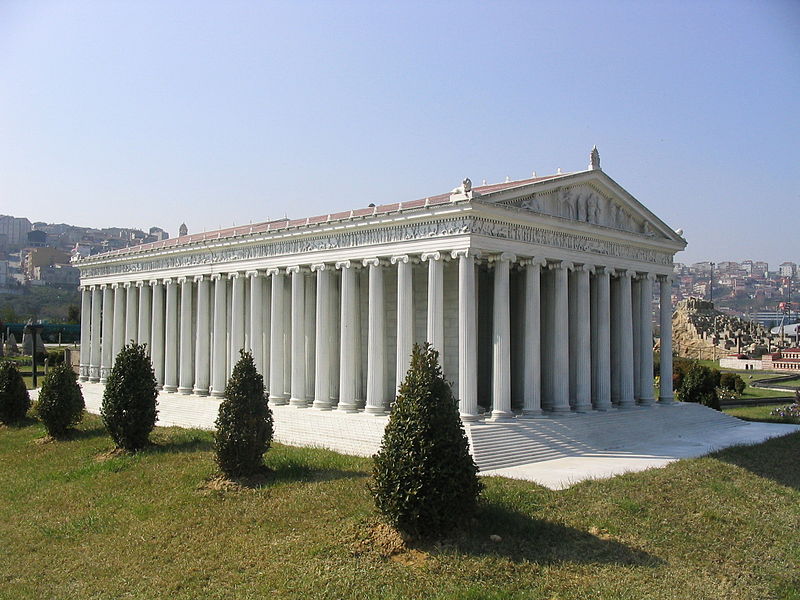
Model of Temple of Artemis, Miniatürk Park, Istanbul, Turkey

The Temple of Artemis, also known less precisely as the Temple of Diana, was a Greek temple dedicated to a goddess Greeks identified as Artemis and was one of the Seven Wonders of the Ancient World. It was located in Ephesus (near the modern town of Selçuk in present-day Turkey), and was completely rebuilt three times before its eventual destruction in 401. Only foundations and sculptural fragments of the latest of the temples at the site remain.
The site of the temple today.

Antipater of Sidon, who compiled the list of the Seven Wonders, describes the finished
temple:
"I have set eyes on the wall of lofty Babylon on which is a road for chariots, and the statue of Zeus by the Alpheus, and the hanging gardens, and the colossus of the Sun, and the huge labour of the high pyramids, and the vast tomb of Mausolus; but when I saw the house of Artemis that mounted to the clouds, those other marvels lost their brilliancy, and I said, "Lo, apart from Olympus, the Sun never looked on aught so grand".


The Temple of Artemis was located near the ancient city of Ephesus, about 50 km south from the modern port city of İzmir, in Turkey. Today the site lies on the edge of the modern town of Selçuk.


domingo, 21 de octubre de 2012

Greek monuments

Epiaduros
Epidaurus (Greek: Επίδαυρος, Epidaurus) was a small city (polis) in ancient Greece, at the Saronic.
Epidaurus was independent of Argos and not included in Argolis until the time of the Romans. With its supporting territory, it formed the small territory called Epidauria. Reputed to be the birthplace of Apollo's son Asclepius, the healer, Epidaurus was known for its sanctuary situated about five miles (8 km) from the town, as well as its theater, which is once again in use today. The cult of Asclepius at Epidaurus is attested in the 6th century BC, when the older hill-top sanctuary of Apollo Maleatas was no longer spacious enough.
The asclepieion at Epidaurus was the most celebrated healing center of the Classical world, the place where ill people went in the hope of being cured. To find out the right cure for their ailments, they spent a night in the enkoimeteria, a big sleeping hall. In their dreams, the god himself would advise them what they had to do to regain their health. Found in the sanctuary, there was a guest house for 160 guestrooms. There are also mineral springs in the vicinity which may have been used in healing.Asclepius, the most important healer god of antiquity, brought prosperity to the sanctuary, which in the 4th and 3rd centuries BC embarked on an ambitious building program for enlarging and reconstruction of monumental buildings. 

Fame and prosperity continued throughout the Hellenistic period. In 87 BC the sanctuary was looted by the Roman general Sulla, and in 67 BC, it was plundered by pirates. In the 2nd century AD, the sanctuary enjoyed a new upsurge under the Romans, but in AD 395 the Goths raided the sanctuary.
Even after the introduction of Christianity and the silencing of the oracles, the sanctuary at Epidauros was still known as late as the mid 5th century, although as a Christian healing center.


sábado, 20 de octubre de 2012

Greek monuments


     The Parthenon


The Parthenon  is a temple on the Athenian Acropolis, Greece, dedicated to the maiden goddess Athena, whom the people of Athens considered their patron. Its construction began in 447 BC when the Athenian Empire was at the height of its power. It was completed in 438 BC, although decoration of the Parthenon continued until 432 BC.although decoration of the Parthenon continued until 432 BC. It is the most important surviving building of Classical Greece, generally considered the culmination of the development of the Doric order. Its decorative sculptures are considered some of the high points of Greek art. The Parthenon is regarded as an enduring symbol of Ancient Greece and of ancient democracy and one of the world's greatest cultural monuments. The Greek Ministry of Culture is currently carrying out a program of selective restoration and reconstruction to ensure the stability of the partially ruined structure.
The origin of the Parthenon's name is from the Greek word "παρθενών"   (parthenon), which referred to the "unmarried women's apartments" in a house and in the Parthenon's case seems to have been used at first only for a particular room of the temple it is debated which room this is and how the room acquired its name.