domingo, 10 de febrero de 2013

Greek myths

Pandora

Pandora: The first woman, a sentence to mankind:
When Prometheus stole fire from the heavens and gave it back to men, angry Zeus was determined to punish mankind for receiving this stolen gift. And his punishment had to be a beautiful and enchanting one, but so deceitful that men would welcome it as gift. It was a woman, the first woman.
According to the myth, Zeus commanded Hephaestus to create Pandora, a beautiful but wicked woman whose children would torment the race of men. After Hephaestus molded her from clay and fire, Athena clothed her in a silver gown and every Olympian god offered her a unique gift. Athena taught her needle craft and weaving, Aphrodite shed grace upon her head but Hermes gift was different… Hermes gave her cunningness and treachery. He gave her the power of speech: putting in her "lies and crafty words" He was also the one who named her “Pandora”, the all-gifted.
He then sent her to Epimetheus to be his wife. Prometheus, his bother warned him not to accept any gifts from Zeus, but he ignored the warnings. Zeus also offered Pandora a sealed box and he demanded she did not open it for any reason. Of course Pandora could not overcome her curiosity to find out what lies inside the box. Not after Zeus’s “warning”… When she opened the box, toil, sickness and diseases and myriad other pains were spread across the earth and the sea. Pandora closed the box in-time only to keep one thing contained, hope.

domingo, 27 de enero de 2013

News

Last-gasp Olympiakos leave Montpellier in need of a miracle:

Olympiakos defended for 70 minutes at Karaiskaki Stadium in Piraeus but walked away with a valuable 3-1 win over Montpellier in the Champions League, thanks to goals from Paulo Machado, Leonardo Greco and Costas Mitroglou.
 The Greek champions play their two remaining games away to Schalke and then at home to Arsenal in Group B, with a shot at qualification to the knock out stages.
 Greco set up the opening goal in the 4th minute, expertly cutting through the French defence to find Djamel Abdoun in the penalty area. The Algerian struck the left post with his shot but Paulo Machado was on hand to chip past goalkeeper Geoffrey Jourden.
 Then, inexplicably, the Greeks sat back, handing Montpellier winger Younes Belhanda an invitation wreak havoc for most of the match.
 The 22-year-old Moroccan finally got the equaliser in the 66th minute, converting a penalty kick.
Croatian referee Marijo Strahonja awarded the spot kick after Soulaymane Camara fell to ground after jostling in the penalty area with Dimitris Siovas.
 "I wasn't close to the incident, but it didn't look like a penalty," Olympiakos defender Giannis Maniatis said. "It made us play more stubbornly and improve our game."
 He was right: Olympiakos sprung to life after appearing hapless for much of the game.
 The French failed to dispose of a corner from Jose Holebas in the 80th minute, and Greco blasted the ball through a crowded penalty area past Jourden to make it 2-1.
 Holebas laid on another two minutes later, his cross met by Mitroglou who had played as a stranded striker all evening before showing little hesitation when his chance came - 3-1 Olympiakos.
 "We were not afraid and players stayed strong," said Olympiakos manager Leonardo Jardim, insisting his players had stuck to their game plan and soaked up pressure from Montpellier after taking the lead.
 "We interrupted their game... I Think the victory was absolutely fair. We have six points left for the taking and we will fight for them."
 Montpellier pulled off a stunning French league win last season, but have not carried their success over to Europe, finishing the night without a Champions League win in four matches.
 "To be realistic, it would take a miracle to get third place in the group," said Montpellier coach Rene Girard. "We collapsed in the last ten minutes. It's happened to us before but I can't explain it."

domingo, 6 de enero de 2013

Greece economy


Commons Wikimedia: Pueblo griego

Greece is a rich country with high human development index (0.947) but within the European Union countries have a more low, so it did not enter the eurozone in 1999 if not in 2002. Greece's economic growth was truncated during a long, hard postwar civil war and dictatorship.Traditionally, agriculture has been one of the main sectors of Greece, more than the population occupying the contribution to the economy. Agriculture accounts for 3% of GDP and is home to 12% of the workforce, industry 20% of GDP and 22% of workers, and services for 77% of GDP and 66% of the workforce.Agriculture has undergone a profound conversion from small farms and little production for the market to competitive agriculture in Europe with medium-sized farms and the benefits of the green revolution. However, this sector is conditioned by an unfavorable physical environment due to the mountainous nature of much of the country. The most productive regions in the north, Macedonia and Thessaly. The main crops wheat and corn, which account for almost half of the production, and industrial crops such as snuff, cotton and sugar beet, and the Mediterranean polyculture of fruits and vegetables along with olives and vines, present in the Peloponnese. This feeds an important agricultural industry, which is outside the production region around Athens, Piraeus, Thessaloniki and Volos.For the mountainous nature of the country's forestry is more important than in most European countries, and livestock has good and abundant grass. The 40% of the territory is grassland. Predominantly sheep and goats, more adapted to the Mediterranean grass, but also cattle, specializing in milk, swine and avian modern.Despite the distinctly Greek marine fisheries is reduced to a nearby fishing grounds and traditional arts.Mining is scarce, although varied: lignite, bauxite, iron, magnesium, marble, some oil, salt, chromium, silver, zinc, gold and lead. Just can feed the needs of the country's industry.


geography


The structural formation of Greece reveals a young relief, formed in the Alpine orogeny, and abundance of limestone karst and subsequent relief. The general set descends from west to east, where the structures are immersed in the sea, leaving only the peaks emerged, forming the countless islands. The proximity to faults that separate the plates African, Eurasian and Arabian makes the region prone to earthquakes and volcanoes. The folded and fractured system, framed by faults is very complex. Fault lines into the sea, and the high block and sunken island status are responsible for much of the country. This fragmentation occurs in multiple directions, however, highlights a dominant structural direction from northwest to southeast, which is marked by mountains Olympus, Pindus and its extension in the Peloponnese.Regarding the geological substrate can differentiate two blocks, each consisting of metamorphic rocks northeastern, old and stiff, fractured by the Alpine orogeny and wherein lies the Rhodope massif, the region of Thrace and Macedonia. This set is completed with some metamorphic southern islands. The rest of the country is mostly limestone fold assembly. He is responsible for the numerous coves along the coast Hellenic cliff and character of much of the coastline.The character cut from the coast, and the many islands that individualize infinite sets in the interior gives a stamp eminently marine Greece. All within the Mediterranean Sea, we can distinguish four seas, the Ionian, the Aegean, Thrace and Crete.The main gulfs in Greece are: the Gulf of Thessaloniki, the Corinthian Gulf, the Gulf of Patras, the Strymonas Gulf, the Gulf of Volos, and the Gulf of Evia

Vegetation


Commons Wikimedia: Paisaje de Grecia

The climate is typically Mediterranean Greek. The Mediterranean climate dominates throughout the country, although Macedonia and Thessaly plains have clear certain continental. However, due to the mountainous climate there is a clear asymmetry between the windward slopes (west) and leeward (east) of the prevailing winds. Furthermore, the constant presence of the sea softens seasonal temperature extremes.
The action centers are affecting Greece, the polar front brings cold air masses from the Mediterranean and humid and the European continent. The Azores High, which comes in the summer, and brings masses of warm, moist air, and the Siberian anticyclone, which comes in winter and cold air masses channels and dry.
The summers are long and warm, but not excessive, thanks to the action of sea breezes and fresh winds from the interior, which blow in summer. Winters are short and not too cold, thanks to the moderating action of the sea. Frosts are few, and average rainfall. The average seasons, spring and autumn are rainy and warm, but its features are very irregular. In autumn cold drops are frequent episodes of torrential rains and flash which are produced by the temperature difference between the sea, very hot, and the arrival of the first polar air masses in height.
Average temperatures range from 7 ° C in the coldest month (January) and 27 ° C for the hottest month (July) in Athens. In the islands these values ​​are moderate, with examples such as Crete, with 10 º C in January and 25 ° C in July, and are extreme in the continental interior with values ​​as Thessaloniki (Macedonia), with 2 ° C in January and 23 º C in July.
Rainfall is low, despite the presence marina. In Athens barely reach the 330 mm per year, in Crete reach the 560 mm and 375 mm to Thessaloniki. Something greater precipitation in the mountains, and in the eastern facade, where over 1,000 mm. Very few of these rainfall as snow, even in the mountains.
Vegetation is typical of Mediterranean forest Greece, which dominates the oak, oak and chestnut. The abundance of limestone are frequent causes of Cliserie investments, and appears above the oak oak. Above find conifers, beech, and alpine meadow. However, the natural vegetation can only find in the most inaccessible mountains, like Mount Olympus, Pindus, and certain points of Arcadia and Peloponnese. The Greek space suffers organized anthropic pressure for thousands of years, and that has determined, largely, the distribution of natural species. Many are degraded areas to deforestation, in which species predominate subserial of garrigue, Mediterranean maquis and steppe. In these areas abound thorny and aromatic species typical of Mediterranean forest, as the kermes, thyme, lavender and rosemary. Greece has not reached operating methods of the Mediterranean forest and the meadow, so characteristic in other Mediterranean regions.
Around the rivers appears abundance gallery forest of poplars, cottonwoods, elms, and other riparian species, typical of the Mediterranean
.

viernes, 4 de enero de 2013

Athens

Athens:
Acropolis of Athens
Athens is the capital and largest city of Greece. Athens dominates the Attica region and is one of the world's oldest cities, with its recorded history spanning around 3,400 years. Classical Athens was a powerful city-state. A centre for the arts, learning and philosophy, home of Plato's Academy and Aristotle's Lyceum, it is widely referred to as the cradle of Western civilization and the birthplace of democracy, largely due to the impact of its cultural and political achievements during the 5th and 4th centuries BC in later centuries on the rest of the then known European continent. Today a cosmopolitan metropolis, modern Athens is central to economic, financial, industrial, political and cultural life in Greece. In 2008, Athens was ranked the world's 32nd richest city by purchasing powerand the 25th most expensive in a UBS study. 
The city of Athens has a population of 655,780,(796,442 back in 2004)within its administrative limits and a land area of 39 km2 (15 sq mi). The urban area of Athens (Greater Athens and Greater Piraeus) extends beyond the administrative municipal city limits, with a population of 3,074,160 (in 2011), over an area of 412 km2 (159 sq mi). According to Eurostat, the Athens Larger Urban Zone (LUZ) is the 7th most populous LUZ in the European Union (the 4th most populous capital city of the EU) with a population of 4,013,368 (in 2004). Athens is also the southernmost capital on the European mainland.

The heritage of the classical era is still evident in the city, represented by ancient monuments and works of art, the most famous of all being the Parthenon, considered a key landmark of early Western civilization. The city also retains Roman and Byzantine monuments, as well as a smaller number of Ottoman monuments. The Greek influence of the city is greatly noted through the stellar artwork of the Greek workers of the city of the city-state of Athens.
Athens is home to two UNESCO World Heritage Sites, the Acropolis of Athens and the medieval Daphni Monastery. Landmarks of the modern era, dating back to the establishment of Athens as the capital of the independent Greek state in 1833, include the Hellenic Parliament (19th century) and the Athens Trilogy consisting of the National Library of Greece, the Athens University and the Academy of Athens. Athens was the host city of the first modern-day Olympic Games in 1896, and 108 years later it welcomed home the 2004 Summer Olympics. Athens is home to the National Archeological Museum, featuring the world's largest collection of ancient Greek antiquities, as well as the new Acropolis Museum.

jueves, 3 de enero de 2013

Greek battlers

Achilles
Achilles:

In Greek mythology, Achilles (Ancient Greek: Ἀχιλλεύς, Akhilleus) was a Greek hero of the Trojan War, the central character and the greatest warrior of Homer's Iliad.
Later legends (beginning with a poem by Statius in the 1st century AD) state that Achilles was invulnerable in all of his body except for his heel. As he died because of a small wound on his heel, the term Achilles' heel has come to mean one's point of weakness.

Achilles' name can be analyzed as a combination of ἄχος (akhos) "grief" and λαός (Laos) "a people, tribe, nation, etc." In other words, Achilles is an embodiment of the grief of the people, grief being a theme raised numerous times in the Iliad (frequently by Achilles). Achilles' role as the hero of grief forms an ironic juxtaposition with the conventional view of Achilles as the hero of kleos (glory, usually glory in war).
Laos has been construed by Gregory Nagy, following Leonard Palmer, to mean a corps of soldiers, a muster. With this derivation, the name would have a double meaning in the poem: When the hero is functioning rightly, his men bring grief to the enemy, but when wrongly, his men get the grief of war. The poem is in part about the misdirection of anger on the part of leadership.
The name Achilleus was a common and attested name among the Greeks soon after the 7th century BC. It was also turned into the female form Ἀχιλλεία (Achilleía) attested in Attica in the 4th century BC (IG II² 1617) and, in the form Achillia, on a stele in Halicarnassus as the name of a female gladiator fighting an "Amazon". Roman gladiatorial games often referenced classical mythology, and this seems to reference Achilles' fight with Penthesilea but gives it an extra twist of Achilles being "played" by a woman.


Greek history (X)

4th century:

Greece thus entered the 4th century under a Spartan hegemony, but it was clear from the start that this was weak. A demographic crisis meant Sparta was overstretched, and by 395 BC Athens, Argos, Thebes, and Corinth felt able to challenge Spartan dominance, resulting in the Corinthian War (395-387 BC). Another war of stalemates, it ended with the status quo restored, after the threat of Persian intervention on behalf of the Spartans.
Delian League,  before the Peloponnesian War 
The Spartan hegemony lasted another 16 years, until, when attempting to impose their will on the Thebans, the Spartans suffered a decisive defeat at Leuctra in 371 BC. The Theban general Epaminondas then led Theban troops into the Peloponnese, whereupon other city-states defected from the Spartan cause. The Thebans were thus able to march into Messenia and free the population.
Deprived of land and its serfs, Sparta declined to a second-rank power. The Theban hegemony thus established was short-lived; at the Battle of Mantinea in 362 BC, Thebes lost her key leader, Epaminondas, and much of her manpower, even though they were victorious in battle. In fact such were the losses to all the great city-states at Mantinea that none could establish dominance in the aftermath.

The weakened state of the heartland of Greece coincided with the Rise of Macedon, led by Philip II. In twenty years, Philip had unified his kingdom, expanded it north and west at the expense of Illyrian tribes, and then conquered Thessaly and Thrace. His success stemmed from his innovative reforms to the Macedon army. Phillip intervened repeatedly in the affairs of the southern city-states, culminating in his invasion of 338 BC.
Decisively defeating an allied army of Thebes and Athens at the Battle of Chaeronea (338 BC), he became de facto hegemon of all of Greece, except Sparta. He compelled the majority of the city-states to join the League of Corinth, allying them to him, and preventing them from warring with each other. Philip then entered into war against the Achaemenid Empire but was assassinated by Pausanias of Orestis early on in the conflict.
Alexander, son and successor of Philip, continued the war. Alexander defeated Darius III of Persia and completely destroyed the Achaemenid Empire, annexing it to Macedon and earning himself the epithet 'the Great'. When Alexander died in 323 BC, Greek power and influence was at its zenith. However, there had been a fundamental shift away from the fierce independence and classical culture of the poleis—and instead towards the developing Hellenistic culture.

lunes, 31 de diciembre de 2012

Greek sculptures

Venus of Milo
Venus of Milo:
Aphrodite of Milos (Greek: Ἀφροδίτη τῆς Μήλου, Aphroditē tēs Mēlou), better known as the Venus de Milo, is an ancient Greek statue and one of the most famous works of ancient Greek sculpture. Created sometime between 130 and 100 BC, it is believed to depict Aphrodite, the Greek goddess of love and beauty (Venus to the Romans). It is a marble sculpture, slightly larger than life size at 203 cm (6 ft 8 in) high. The arms and original plinth were lost following the discovery. From an inscription that was on its plinth, it is thought to be the work of Alexandros of Antioch; earlier, it was mistakenly attributed to the master sculptor Praxiteles. It is currently on permanent display at the Louvre Museum in Paris.
Description:

Although the Aphrodite of Milos is widely renowned for the mystery of her missing arms enough evidence remains to prove that the right arm of the statue was lowered across the torso with the right hand resting on her raised left knee so it would seem to hold the sliding drapery wrapped around the hips and legs in place.[citation needed] There is a filled hole below her right breast that originally contained a metal tenon that would have supported the separately carved right arm.
The left arm was held out below the eye level of the statue, above a herm and held an apple. The right side of the statue is worked more carefully and finished in greater detail than the left side or back, indicating that the statue was intended to be viewed in profile from its right. The left hand would have held the apple up into the air further back inside the niche the statue was set in. When the left hand was still attached, it would have been clear to an observer that the goddess was looking at the apple she held up in her left hand.
The statue would have been painted, as was the Greek custom for statuary,adorned with jewellery, and positioned in a niche inside a gymnasium. The painting of the statue along with the bedecking in jewellery were intended to make it appear more lifelike. Today, all traces of any paint have disappeared and the only signs of the armbands, necklace, earrings and crown are attachment holes.
The twisting stance and strong projection of the knee, as well as the rich, three-dimensional quality of the drapery, are typical of Hellenistic art of the third century BC and later. Moreover, the sensuous juxtaposition of flesh with the texture of drapery, which seems about to slip off the figure, adds an insistent note of erotic tension that is thoroughly Hellenistic in concept and intent.

Education in Greece (V)

The library of the Technical University
Obsolete institutions:

.Technical Vocational School, TCG (Techniko Epagelmatiko Ekpedeftirio - Technical Vocational .School, TEE)
.Technical Vocational High School, FT (Techniko Epagelmatiko Lykeio - Technical Vocational .Lyceum, TEL)
.Technical Vocational School, TES (Techniki Epagelmatiki Scholi - Technical Vocational School, TES)
.Unified High School, EPL (Eniaio Polykladiko Lykeio - Unified Multidisciplinary Lyceum, EPL)
Current issues:

The foremost topic of debate in recent years has been recognition of the private universities, which are forbidden by the 1975 constitution. Numerous private institutions, which are often franchises of European and American universities, such as State University of New York, but also non-profit accredited institutions or wholly owned and operated branch campuses of foreign universities, such as the University of Indianapolis - Athens Campus, are operating legally as EES schools (translatable as "Laboratories of Free Study").
Moreover, with few exceptions, the Greek government refuses to recognize three-year university degrees. Students who completed a Bachelor's degree in a foreign country find it difficult to secure employment in the public sector, unless they next obtain a Master's degree, in which case their academic qualifications are considered equivalent to a four-year undergraduate degree conferred by a Greek higher educational institute.
Following pressure from the EU member states, within the framework of the Bologna Process, Greece is revising its classification of degrees to bring it in line with the framework defined in the European Credit Transfer and Accumulation System/ECTS. (It is usually the goal to accomplish a bachelor degree within 3 years and a master degree within 2 years.)

domingo, 30 de diciembre de 2012

Basketball in Greece (IV)

Junior national teams:
The Greek junior national team won a gold medal at the 1995 junior men's FIBA Under-19 World Championship. As the tournament's host nation, the Greek junior national team won the gold medal by defeating the junior men's Australia national basketball team by a score of 91-73 in the final. The gold medal winning under-19 team of 1995 included such players as: Michalis Kakiouzis, Nikolaos Hatzis, Giorgos Kalaitzis, Dimitrios Papanikolaou, and Efthimios Rentzias, who was voted the MVP of the tournament.
Mediterranean Games:

Greece has also always taken part in the Mediterranean Games. The greatest success of the men's national team at the Mediterranean Games is the gold medal, which they won in 1979. Furthermore, Greece has won four silver medals at the tournament, in the years 1991, 2001, 2005, and 2009. In addition to that, they have also won three bronze medals at the tournament, in the years 1955, 1971, and 1987.
The Greek women's national team won the bronze medal at the competition in 1991.
Arenas:

The first professional indoor basketball arena in the country was opened in 1959 in Athens. Located at the Apostolos Nikolaidis Stadium, it holds 1,500 spectators and is still home to the ladies' basketball department of Panathinaikos. Because of its confined environment, the sports hall was named The Tomb of The Indian, after the Fritz Lang feature film The Indian Tomb. In the subsequent years, a number of other arenas have arisen in Greece, located mainly in Athens and Thessaloniki. In 1966, in Thessaloniki, the Alexandrio Melathron was opened. This 5,500 seat arena was for decades home to the two arch-rivals Aris and PAOK.
The Peace and Friendship Stadium (SEF), a 17,000 capacity multi-purpose hall opened in Piraeus, Athens in 1985. The arena was for the next ten years, the biggest indoor sports hall in Greece and it hosted events such as the EuroBasket 1987, the 1994 World Volleyball Championship, the 1995 European Volleyball Championship, the 1998 FIBA World Championship, and the 1999 Olympic Weightlifting World Championship. SEF is the home of the Olympiacos Piraeus basketball club.
By the early 1990s, the sport of basketball had become well established in Greece and the Greek A1 League had become the strongest professional league in Europe, as well as the richest. A rising number of television viewers in Greece watching the A1 League, a high level of Greek media interest in the sport, and the application of the country to host major sports events had left many of the nation's existing gyms too old and too small. In Athens, the OAKA Indoor Hall was opened in 1995. It holds about 20,000 spectators and it is still the biggest indoor sports hall in Europe where regular basketball games are held. The Athens Olympic Indoor Hall has already hosted the 1995 FIBA Under-19 World Championship, the EuroBasket 1995, the 1998 FIBA World Championship, and the 2004 Summer Olympics. Currently, Panathinaikos Athens and Maroussi Athens play home matches in the Olympic Hall. AEK Athens has played home matches there.
Also in 1995, the 5,500 capacity arenas Larrisa Neapolis and Dimitris Tofalos were built. In 2000, the first modern indoor sports arena in Thessaloniki was built, PAOK Sports Arena. The arena is under the possession of PAOK and it holds around 8,700 spectators. For the 2004 Olympic Games, the Helliniko Indoor Arena was built. It holds 15,000 spectators and has been used as the home arena of the clubs Panionios, Panellinios, and AEK Athens.
Plans have been approved to build several new modern indoor arenas in Greece. This is due to several factors, one of them being ULEB's new arena rules which state that by the 2012-13 season, Euroleague contract clubs must play in arenas that seat at least 10,000 and all Eurocup clubs must play in arenas that seat at least 5,000. Another big reason is that Greece is in line to host the 2013 Mediterranean Games. Some of these planned new indoor halls will include: a 10,000+ seat arena owned by Panathinaikos, a 10,000+ seat arena owned by Aris, and a 5,000+ seat arena owned by Iraklis.

sábado, 29 de diciembre de 2012

Gastronomy

Greek Oysters:
Oysters have been a favorite of Greek gourmets, since Aristotle first documented their habits and virtues in his "Zoological". These tasty bivalves have captivated the appetites of gourmands from time immemorial, too, such as that of the Roman emperor Vitelius, who is said to have consumed one thousand oysters in one sitting. Seneca supposedly ate a thousand a week. Writers, from Shakespeare (who coined the famous phrase "the world is my oyster") to Balzac to Lord Byron, have waxed poetic about this tasty treat, too.
Greek Oysters
Still, much is owed to the acumen of ancient Greek aqua farmers, regarding the cultivation of the oyster. Although other ancient peoples, namely the North American coastal Indians, were eating wild oysters long before Aristotle documented their habits, it was the ancient Greeks who probably first cultivated them. According to various sources, the earliest cultivations date back to the 4th century B.C., to the island of Rhodes. Local fishermen apparently first noticed that tiny oysters, attached themselves to shards of broken pottery in the sea and there found a place to grow and reproduce. It didn't take long, before the fishermen started placing pottery in the sea, specifically to help the mussels flourish. Other tales point to Lesvos, where local fishermen noticed that large quantities of oysters seemed to grow but not reproduce around specific water current.
The two basic tenets of oyster farmers were hence discovered that the bivalve can grow easily in some places but can only reproduce under certain conditions. To this day, oyster farming is based on that same principle. There are numerous varieties of oysters all over the world. In the Mediterranean, the most commonly encountered belongs to the genus Ostrea, with local species from Gibraltar to Israel; Greek oysters tend to be small and quite tasty. The best are said to be found in the many coves of Halkidiki and in the Thermaikos Gulf. A common folk belief is that oysters should not be consumed during the months whose names do not contain the letter "R" -in other words, during the summer
Preparation:

Saute the pork in 1 tablespoons of olive oil, until it browns lightly. Add the pepper and saute for a minute to soften. Add the vinegar, remaining olive oil, salt, pepper and oysters, together with their juices. As soon as the oysters warm through, remove. Place the spinach on a serving platter or in a large salad bowl and top with the oyster-pork mixture. Serve immediately.

viernes, 28 de diciembre de 2012

Painting

Theofilos (Chatzimichail):

A self-taught folk painter with inspiration and sensitivity that went far beyond the conventionalism of folk art. Born in Mitilini, he spent most of his life there and in the villages of Mt. Pilio, painting the walls of private dwellings and shops and, more rarely, the surfaces of portable objects. He portrayed historical subjects and genre scenes in a unique combination of iconographic symbols.
Theofilos (Chatzimichail)
His talent lays in the assimilation of past conventions into a personal style that evokes a deep faith in his visions, apparent in all his works. With an exceptional feeling for color, the immediacy and simplicity of his figures, recalled the artistic conceptions of Matisse and Fauvism. It is amazing how he conveyed the sense of space and analogies, in a way that made all seem dreamy and poetic. The great poets, Seferis and Elytis, wrote of his power to give expression to the true face of Greece. For Tsarouhis, he "belongs in the company of wise men and lunatics whose blessed megalomania smashed the confines of academicism". A unique persona dressed as Alexander the Great in a traditional "foustanela", half-crazed and removed in his own world, he broke the aesthetic barriers of Modern Greek art and pointed to a new direction of unique self-expression. The generation of the 1930s owes a lot to his work.

News

Small majority for austerity raises big doubts:
Prime Minister Samaras applauds with lawmakers after Wednesday night's vote (Reuters)

A stormy all-day debate in parliament on Wednesday culminated in a flimsy majority of 153 MPs approving the harsh austerity package of 13.5bn euros worth of mostly wage, pension and welfare cuts in the next two years, with a further 5bn euros of cutbacks in 2015-16, as dictated by the troika of Greece’s creditors.
 “The vote’s result marks a large, decisive and encouraging step towards economic recovery and better days for the country as a whole,” said Prime Minister Antonis Samaras after the results of the vote count were announced shortly past midnight.


“We’ve sent a strong message [abroad] that Greece has turned a page,” he added.
 Parliament was besieged by tens of thousands of protesters in the afternoon while opposition lawmakers from left-wing Syriza and conservative Independent Greeks often interrupted the debate with motions of constitutional or parliamentary irregularity.
 This further undermined the 250-page, one-article bill’s legitimacy, which had already been denied by two landmark high-court rulings, one by the State Auditors’ Council on Monday and another by the Supreme Court on Wednesday.

miércoles, 26 de diciembre de 2012

Greek kings

Queen Sofia of Spain
Queen Sofía of Spain:
Queen Sofía of Spain born 2 November 1938 is the current queen consort and wife of King Juan Carlos I of Spain.
Early life:

Princess Sophia of Greece and Denmark was born in Psychiko, Athens, Greece on 2 November 1938, the eldest child of the King Paul of Greece (1901–1964) and his wife, Queen Frederika (1917–1981), a former princess of Hanover. Queen Sofia is a member of the Schleswig-Holstein-Sonderburg-Glücksburg dynasty. Her brother is the deposed King Constantine II of Greece and her sister Princess Irene of Greece and Denmark. However, since the abolition of the Greek monarchy, the royal titles are recognized by the Dutch Monarchy and the Danish Royal Family.
Princess Sophia spent some of her childhood in Egypt where she took her early education in El Nasr Girls' College (EGC) in Alexandria, then went to South Africa during her family's exile from Greece during World War II. They returned to Greece in 1946. She finished her education at the prestigious Schloss Salem boarding school in Southern Germany, and then studied childcare, music and archeology in Athens. Sofia also studied at Fitzwilliam College, Cambridge a constituent college of the University of Cambridge. She represented Greece, alongside her brother then-Crown Prince Constantine, as a reserve member of the Gold Medal-winning sailing team in the 1960 Summer Olympics.
Marriage and family:

On 14 May 1962, Princess Sophia of Greece and Denmark married Infante Juan Carlos of Spain, whom she met on a cruise in the Greek Islands in 1954, in Athens at the Catholic Cathedral of Saint Dennis. She converted from Greek Orthodoxy to Roman Catholicism to become more palatable to Catholic Spain, and thus relinquished her rights to the Greek Throne. Along with this, the usual Latin spelling of her Greek name (Σοφία) was changed from Sophia to the Spanish variant Sofía.
In 1969, Prince Juan Carlos, who was never Prince of Asturias (the traditional title of the heir presumptive), was given the official title of "Prince of Spain" by the Spanish state; the title suggested by Sofía herself. Juan Carlos acceded to the throne as Juan Carlos I of Spain in 1975.
The couple have three children: HRH Infanta Elena, Duchess of Lugo (born 20 December 1963); HRH Infanta Cristina, Duchess of Palma de Mallorca (born 13 June 1965); and HRH Felipe, Prince of Asturias (born 30 January 1968). The King and Queen have eight grandchildren, four boys and four girls: Felipe and Victoria from the Infanta Elena; Juan, Pablo, Miguel and Irene from the Infanta Cristina; and Infanta Leonor, and Infanta Sofía, named in her honor, of Prince Felipe; all of whom are in the line of succession to the Spanish Throne.

Greek history (IX)

5th century:
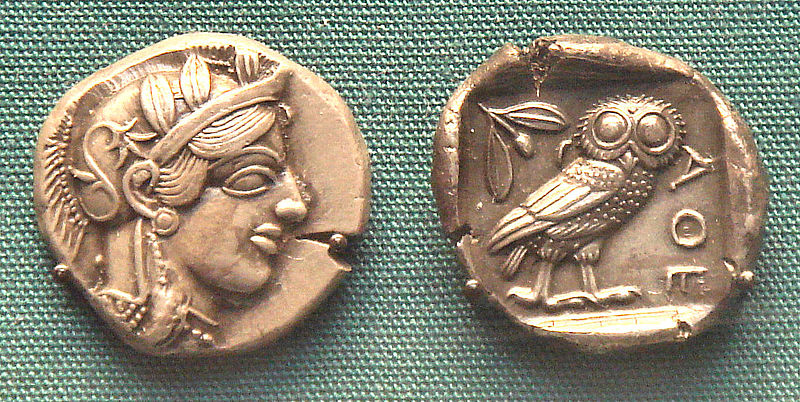
Athenian coin, depicting the head of Athena and her owl

Athens and Sparta would soon have to become allies in the face of the largest external threat ancient Greece would see until the Roman conquest. After suppressing the Ionian Revolt, a rebellion of the Greek cities of Ionia, Darius I of Persia, King of Kings of the Achaemenid Empire, decided to subjugate Greece. His invasion in 490 BC was ended by the Athenian victory at the Battle of Marathon under Miltiades the Younger.
Xerxes I of Persia, son and successor of Darius I, attempted his own invasion 10 years later, but despite his larger army he suffered heavy casualties after the famous rearguard action at Thermopylae and victories for the allied Greeks at the Battles of Salamis and Plataea. The Greco-Persian Wars continued until 449 BC, led by the Athenians and their Delian League, during which time the Macedon, Thrace, the Aegean Islands and Ionia were all liberated from Persian influence.
Attic red-figure pottery,ca. 480 BC (Paris, Louvre)
The dominant position of the maritime Athenian 'Empire' threatened Sparta and the Peloponnesian League of mainland Greek cities. Inevitably, this led to conflict, resulting in the Peloponnesian War (431-404 BC). Though effectively a stalemate for much of the war, Athens suffered a number of setbacks. The Plague of Athens in 430 BC followed by a disastrous military campaign known as the Sicilian Expedition severely weakened Athens. An estimated one-third of Athenians died, including Pericles, their leader.
Sparta was able to foment rebellion amongst Athens's allies, further reducing the Athenian ability to wage war. The decisive moment came in 405 BC when Sparta cut off the grain supply to Athens from the Hellespont. Forced to attack, the crippled Athenian fleet was decisively defeated by the Spartans under the command of Lysander at Aegospotami. In 404 BC Athens sued for peace, and Sparta dictated a predictably stern settlement: Athens lost her city walls (including the Long Walls), her fleet, and all of her overseas possessions.

lunes, 24 de diciembre de 2012

Greek sculptures

Antikythera Ephebe:
Antikythera Ephebe
The Antikythera Ephebe is a bronze statue of a young man of languorous grace that was found in 1900 by sponge-divers in the area of an ancient shipwreck off the island of Antikythera, Greece. It was the first of the series of Greek bronze sculptures that the Aegean and Mediterranean yielded up in the twentieth century which have fundamentally altered the modern view of Ancient Greek sculpture.The wreck site, which is dated about 70–60 BC, also yielded the Antikythera Mechanism, an astronomical calculating device, a characterful head of a Stoic philosopher, and a hoard of coins. The coins included a disproportionate quantity of Pergamene cistophoric tetradrachms and Ephesian coins, leading scholars to surmise that it had begun its journey on the Ionian coast, perhaps at Ephesus; none of its recovered cargo has been identified as from mainland Greece.
The Ephebe, which measures 1.94 meters, slightly over lifesize, was retrieved in numerous fragments. Its first restoration was revised in the 1950s, under the direction of Christos Karouzos, changing the focus of the eyes, the configuration of the abdomen, the connection between the torso and the right upper thigh and the position of the right arm; the re-restoration is universally considered a success.
Antikythera Ephebe

The Ephebe does not correspond to any familiar iconographic model, and there are no known copies of the type. He held a spherical object in his right hand,and possibly may have represented Paris presenting the Apple of Discord to Aphrodite; however, since Paris is consistently depicted cloaked and with the distinctive Phrygian cap, other scholars have suggested a beardless, youthful Heracles with the Apple of the Hesperides. It has also been suggested that the youth is a depiction of Perseus holding the head of the slain Gorgon. At any rate, the loss of the context of the Antikythera Ephebe has stripped it of its original cultural meaning.
The Ephebe, dated by its style to about 340 BC, is one of the most brilliant products of Peloponnesan bronze sculpture; the individuality and character it displays have encouraged speculation on its possible sculptor: perhaps it is the work of the famous sculptor Euphranor, trained in the Polyclitan tradition, who did make a sculpture of Paris, according to Pliny:
"By Euphranor is an Alexander [Paris]. This work is specially admired, because the eye can detect in it at once the judge of the goddesses, the lover of Helen, and yet the slayer of Achilles."
The Antikythera Ephebe is conserved in the National Archaeological Museum of Athens.


domingo, 23 de diciembre de 2012

Education in Greece (IV)

Amphitheater Alexander Tzioumis
Tertiary Education in Greece:
Higher Educational Institutes are consisted of two parallel sectors: the Universities and the Higher Technological Educational Institutes (T.E.I.). In addition, colleges collaborating with foreign universities can offer undergraduate and postgraduate UK foreign programmes of study in Greece, under the proper registration with the Greek Ministry of Education. Usually, these programmes are provided following franchise or validation agreements with universities established in other European Union countries, primarily in the UK, leading to degrees which are awarded directly by those universities. In some cases these institutions are wholly owned and operated branch campuses of foreign institutions, as in the case of the University of Indianapolis - Athens Campus. List of universities in Greece.
Private Education:

There are public and private dimotika (primary education), gymnasia (middle school; secondary education), lykeia (high school; secondary education). Some of them are for foreigners, usually children of British or American families. For example see American Community Schools.
Public and private IEK.
According to the article 16 of the Greek constitution, private tertiary education was not allowed in Greece. However there were some Laboratories of Free Studies (Ergastiria Eleutheron Spoudon), often franchises of foreign universities, sometimes non-profit organizations, which advertised themselves as private universities or as centers from public universities abroad. For example see DEI College/University of London International Programmes and UCLan, I.S.T. College/University of Hertfordshire, New York College[disambiguation needed], BCA Business College of Athens, ALBA Graduate Business School, University of Wales, Bangor, Mediterranean College, Deree College, etc.
Following changes in the Greek legislation, in 2008 and 2010, private organisations have been authorised to offer foreign undergraduate and postgraduate programmes under the monitoring of the Greek Ministry of Education. Ministry of Education List of Authorised Colleges

sábado, 22 de diciembre de 2012

Basketball in Greece (III)

Medals:
Basketball WC 2006 Final

The senior men's Greek national basketball team took part in its first FIBA European Championship (EuroBasket) at the EuroBasket 1949, where they won the bronze medal. Greece's first big success as a nation in basketball was when their senior men's national team won the gold medal at the EuroBasket 1987, which led to a breakthrough for the sport of basketball in the country. In the EuroBasket 1987 tournament's final, which was played in Piraeus, Greece, at Peace and Friendship Stadium (SEF), Greece defeated the heavily favored Soviet national basketball team (which included star player Šarūnas Marčiulionis) in overtime, by a score of 103 to 101.
The MVP of the EuroBasket 1987 was Nikos Galis, who to this day, still remains the biggest sports icon in Greece. In the subsequent EuroBasket tournament in 1989, Greece again reached the final, where they lost to the Yugoslavia national team, which led by its star player Dražen Petrović, went undefeated during the tournament. By taking the silver medal at the EuroBasket 1989, Greece cemented its position among Europe's leading basketball nations.
Greece also won the gold medal at the EuroBasket 2005, which was held in Serbia, after defeating Dirk Nowitzki-led Germany in the finals, by a score of 78 to 62.
Greece's senior men's national basketball team took part in a World Championship (now known as the FIBA Basketball World Cup) for the first time at the 1986 FIBA World Championship, where they finished in tenth place. Greece made it to the semifinals of both the 1994 FIBA World Championship and the 1998 FIBA World Championship, which Greece also hosted. At the 2006 FIBA World Championship, which was held in Japan, Greece won the silver medal, after defeating the heavily favored USA by a score of 101-95 in the semifinals.

Gastronomy

Greek Meze
Meze:
Meze or mezze ( /ˈmɛzeɪ/) is a selection of small dishes served in the Mediterranean, Middle East and Balkans as breakfast, lunch or even dinner, with or without drinks. In Levantine cuisines and in the Caucasus region, meze is served at the beginning of all large-scale meals.
The word is found in all the cuisines of the former Ottoman Empire and comes from the Turkish meze "taste, flavour, snack, relish", borrowed from Persian مزه (maze "taste, snack" < mazīdan "to taste").The English word was probably borrowed from the Greek version mezés (μεζές).

Turkish meze often consist of beyaz peynir (literally "white cheese"), kavun (sliced ripe melon), acılı ezme (hot pepper paste often with walnuts), haydari (thick strained yoghurt like the Levantine labne), patlıcan salatası (cold aubergine salad), beyin salatası (brain salad), kalamar (calamari or squid), enginar (artichokes), cacık (yoghurt with cucumber and garlic), pilaki (foods cooked in a special sauce), dolma or sarma (rice-stuffed vine leaves or other stuffed vegetables, such as bell peppers), and köfte (meatballs).
In Greece, Cyprus and Balkans, mezé, mezés, or mezédhes (plural) are small dishes, hot or cold, spicy or savory. Seafood dishes such as grilled octopus may be included, along with salads, sliced hard-boiled eggs, garlic-bread, kalamata olives, fava beans, fried vegetables, melitzanosalata (eggplant salad), taramosalata, fried or grilled cheeses called saganaki, and fresh Greek sheep, goat or cow cheeses (feta, kasseri, kefalotyri, graviera, anthotyros, manouri, metsovone and mizithra). Other offerings are fried sausages, usually pork and often flavored with orange peel, bekrí-mezé (the "drunkard's mezé", a diced pork stew), and meatballs like keftédes and soutzoukákia smyrnéika.
https://www.youtube.com/watch?v=2rv0_hyrvgE